Thursday, 17 February 2011

1: SCOTT PILGRIM VS. THE WORLD


Where to begin with this film. The ultimate hybrid genre film, not just within film genre but media genre. A film where the energy to it never seems to putter out in the same fashion as so many other action films/ comic book films of the multiplex. The jokes that are genuinely funny. The celebration of youth, imagination, romance, music, video games and heartache. The film is all those things – and never once does the barrage of colours, dialogue and effects ever overwhelm the story, which is at its heart a young romance, with fights.

Firstly, there’s the cast. Michael Cera, so often either underrated or criticised for his comic timing (when was Gene Wilder, Charles Grodin or Jack Black ever criticised of being the same in every film) is a revelation here in the title role. Perfectly awkward in the dialogue scenes without seemingly ridiculous when presented with the task of the fight scenes. Despite being a rather difficult character to truly support, given his treatment of his girlfriends, Cera transforms his neuroses into a rather endearing trait and wins the audience over in essentially presenting us with a young man feeling worthless in a relationship with a girl whom he worships. Winstead also achieves the difficult part of making her nihilist Ramona seem alluring. Despite her seeming rather remote and isolated from the story she is entirely believable as Scott’s dream girl. Mysterious, mature and undeniably glibp; when written down this sounds like a girl who you would hate. In reality, these characteristics are precisely the reason guys fall in love with them in the first place. Wong is a revelation though. A complete unknown before the film, her energy and hair trigger personality are a joy to watch. Both hilarious at times and hugely emotionally overwhelming. You secretly find yourself routing for her the whole way through.

The supporting cast of friends and family are great as well. Alison Pill’s droll drummer Kim, Mark Webber’s neutrotic Stephen and Johnny Simmons’ virtually comatose Young Neil are hilarious in their small roles of the band trying to break out of the garage scene. Similarly, Aubrey Plaza and Anna Kendrick’s tiny roles are instantly ingrained into your psyche despite being on screen for all of five minutes apiece. Kieran Culkin’s Wallace is a joy; a gay character that is neither camp nor a stereotype, as can often be the case with Hollywood films’ portrayals. The exes themselves are all in their own way brilliant. Chris Evans and Brandon Routh’s brief appearances are entirely different, unique and hilarious without ever seeming tongue-in-cheek. Jason Schwartzman in particular creates wonderfully narcissistic and arrogant character that is funny to watch and easy to dislike.

Beyond the cast, there’s the look. A collision of Tokyo bubble gum pop (that’s the closest to description I could find) and sharply contrasting realism. One second you can be in the drab bathroom of Young Neil’s house and in an instant the sharp tones of dream state occur. To the eternal credit of cinematographer Bill Pope these contrasting schemes never jar, they cohabit wonderfully and give the film a unique and genuinely original appearance that feels as though it can never be replicated. In the third act within the Chaos Theatre, which feels like a Flash Gordon serial with a budget, the neon hues feel in keeping with the story. The comic book font interrupting the scenes further feels natural in the narrative, and never alien.
Then there’s the sound. An electronica, symphonic hybrid score by music producer icon and unofficial Radiohead member, Nigel Godrich that recalls the unique tone of Jonny Greenwood’s There Will Be Blood score. Not in terms of sound but in terms of its daring – it is a score that feels identifiably fresh and innovative. Then there’s the bands Sex Bob-Omb, Crash and the Boys, The Clash at Demonhead and The Katanayagi Twins all sound like real bands, and entirely separate entities. Not carbon copies of the same artist. Credit to Beck, Broken Social Scene, Metric and Cornelius for creating the respective bands’ sounds. You wish some of them would tour.

The fights themselves are perfectly executed. Different in execution every time and never suffering from low energy or repetition, whilst maintaining the humour of the dialogue scenes. Like the film itself, the fights never forget the gaming influences or the comic book influences and thusly feeling a part of the film rather than a pause to the drama or design that came just before it. Much like a musical, the fights act as merely an extension of the drama that came before it.

The true hero of this movie is the director Edgar Wright. Cutting his teeth in British comedy for years before his two wonderful features, Shaun of the Dead and Hot Fuzz. His style and often overlooked writing acclimatise perfectly with the American sensibilities of the studio and the film remains undeniably Wright’s work. Moreover, the film remains undeniably Wright. There is no watering down of the energy and wit of his earlier work, as many directors often experience when faced with the Hollywood machine.

But the true sign that Scott Pilgrim vs. The World is a great movie is its repeat viewing. The film completely holds up watch after watch. Every joke a joy to hear again. Every fight as thrilling. Seek it out, recall your youth and imagination. The film will bring it all back and have you yearning for youth yet again.

Wednesday, 16 February 2011

2: THE SOCIAL NETWORK


To get the hysterical statement out of the way The Social Network is this generation’s Wall Street. Like that film, it is a story concerned with greed and its mistaken belief of providing happiness to its owner. It is also a film about friendship, not the virtual but the real. It is a film entirely concerned with capitalism and the American Dream, and the American college system offering the perfect spectrum through which to examine these ideas.

For a film so concerned with ideas it takes a world-class writer and director to pull off not just an educational film, but an entertaining one. Aaron Sorkin, arguably the greatest living writer (no overstatement), has written a film about young twenty somethings without sacrificing his phenomenal dialogue. The film is paced wonderfully with machine-gun prose making everything seem immediate and intelligent without it ever seeming verbose or arch. It would not do the writer justice to merely quote his dialogue back in this review, needless to say, with a cast of virtual unknowns he has probably single-handedly provided them with the move to the top of casting wish lists.

The film, unjustifiably so, is often referred to as Sorkin’s film, not Fincher but what has clearly taken place here is a collaboration. There is no way Sorkin would have made the decision to shoot the film like a gothic horror, or cast actors who would decidedly revel in the pathos and egotism rather than try to find sympathy. Simply this is merely another string to Fincher’s already heaving bow. Zodiac previously proved the man could direct an adult, mature film without the need for visual fireworks to compliment his film. The Social Network more than any previous film in the director’s canon is a mature one. Not that Fincher has ever made a juvenile film, in fact from a young age he has dealt with incredibly important, dark and challenging material, but this is a film that absolutely depends on the human condition. The unseen. The thought process. What Fincher does so masterfully is he never lets the patter falter or feel the need to bring the usual visual gait to the story. Often overlooked by the Academy given his rather acidic tales prior, this is a film that can give Fincher his long overdue award without making the academy seem off-kilter.

Performance wise it is undeniably the best performed Fincher movie ever. A cast of young, mostly unknown actors all inhabit their characters, particularly Jesse Eisenberg and Justin Timberlake. Eisenberg, now nominated and equally criticised, brings tiny moments to Zuckerberg making him sympathetic through his sheer hatred for those around him. His performance is filled with small tics and quirks; and an intensity that never erupts into a verbal or physical assault. He plays Zuckerberg like a shell of a man who has barely started adulthood and it is entirely deserving of the accolades he is receiving. His character is horrible but never played as a hissable villain. Timberlake also plays entirely against what the audience expectation of his character is. Never anything less than suave and loaded with charisma his veneer never topples away, yet consistently allows the audience to see his character is not quite as honest as one would have hoped. The rest of the cast are equally wonderful, though Eisenberg and Timberlake make their roles seem effortless which is something acting should always appear to be but rarely does. Special mention should also go to Andrew Garfield and Armie Hammer. Garfield for bringing a crumbling intensity to his Eduardo Saverin, and Hammer for playing two roles and making them feel entirely individual from one another.

Social Network is being referred to heavily as a zeitgest film. A movie capitalising on current headlines to sell tickets, seem instantly relevant and momentarily down with the kids. For starters the film is not in the slightest bit about facebook, in much the same way The Godfather is not about the Mafia. This is a film, ultimately, about friendship. A far more significant and universal theme in the end. Its sadness and power stemming from the fact that a man gains the world as a friend, but loses the only real one he ever had.

Its final image is about as heartbreaking and blackly comic as any other film you are likely to see last year or any other year for that matter.

Saturday, 12 February 2011

3: THE ROAD


John Hillcoat is not a particularly well known director. His previous film, The Proposition was one of the bleakest westerns ever made. Driven by searing violence and outstanding performances. It took a rather tired genre and elevated into something that fresh and different and rather intriguingly original.

The Road marks a more difficult task. Here he is adapting a beloved bestseller by one of the darkest novelists of all time. Cormac McCarthy, perhaps best known as the writer of No Country for Old Men (adapted to Oscar winning success by the Coen Brothers in 2007) received worldwide success with The Road. Its tale of a father and son travelling across the post apocalyptic wasteland of America became a housewives favourite when the book became part of Oprah’s book club. The novel is full despair, nihilism, cannibalism, violence, suicide and there is barely a glimmer of hope in the entirety of the story.

The film is an equally hard sell as it features none of the action that films like Mad Max or Book of Eli offer to help elevate the ideas the genre so often lavishes upon itself. Hillcoat, rather brilliantly, chooses to focus entirely on the relationship of the father and son and merely have the horror of decaying humanity at the back drop. Viggo Mortensen and Kodi Smit-McPhee might as well be related because their relationship never feels false. Never do any of their scenes feel like actors trying to emote. It is such a tragedy this film was entirely overlooked by the awards because both gave the sort of performances actors dream of doing. No matter how bleak their conversation the pair feel wholly real and truly in love with one another. The grim scenes of the father teaching his son how to kill himself or preparing to murder his son if they are found is horrifying but feel wholly real and a product of familial love. The film is virtually dependent on these two actors and rather interestingly if there had been more characters to fill up the screen, the film would never have felt so personal. The rare encounters with other characters often, rather strangely, drag the film down. Conversations turn from their relationship to ideas on morality and God. There is nothing wrong with this but the film is so entirely about how these two communicate with each other that it often slows the pace of an already slow film. Despite the pacing Hillcoat never lets the film drag which is essential given the dependence upon the actors.


The landscape is an equally brutal and realised one. Colour is never present in the film. It is a place where everything lacks life with trees burning in the distance or falling dead. The road lined with corpses, decapitations and decay. The hunt for food always essential and never located. Rarely has a film had the need for survival feel more urgent. To the eternal credit of Hillcoat, he manages to find a beauty in the film’s unforgiving terrain that seems impossible when described. The remains of civilisation take on a rather bleak poetic imagery in the film which is simply stunning to watch. On the rare occasions when Hillcoat’s camera takes in the wider countryside, instead of his performers, the visuals are jaw dropping, especially when the budget was rather low on this film. Nothing about the film feels false or manufactured. In this regard the film feels almost documentary like in its tone. As if the camera is not there to judge but merely to capture. The story never once judges the actions of its characters or implies anything.

The film is a masterpiece for feeling so wholly fresh and original. A film completely foreign and alien yet undeniably real. Its leads astonishing and its director marked for greatness for never schmaltzing the film up in any conceivable manner but merely showing us the horrors. If the final reel does not have you in tears, you simply are not human. Hillcoat should soon be a filmmaker everyone knows.


4: UP IN THE AIR


One of the most honourable achievements of Jason Reitman as a filmmaker is that he is utterly unconcerned with marking his film with an identifiable style. Unlike the Finchers and Scorseses of the world, Reitman merely adopts a style that suits the story he is telling. Thusly, Juno was far more stylised with animation and wild colour schemes. Up in the Air is the least showy of Reitman's work to date, it is also his best arguably providing a mature, blackly comic look at the modern world. While it definitely shares a lot of the same characteristics as Reitman's debut, Thank You for Smoking, the film has a far more interesting concept and ultimately a more relevant one.

Up in the Air arrived in cinemas as the world licked its economic wounds following the worst recession in decades. The film framed itself within this uncomfortably recognisable world as thousands of people finally were forced out from under the blanket of comfort their jobs or careers had offered them for an age. Reitman peppers the film with imagery to this effect but his primary concern is what is said rather than what is seen. George Clooney's Ryan Bingham sits atop the actor's finest work playing a role that acknowledges Clooney’s undeniable charisma and his rather self-imposed bachelorhood but turning it on its head. His charisma is instead a tool to calm those whom he has to tell their world as they know it is about to change. The film settles interestingly into a sub-genre populated by the likes of Taxi Drier and Leon, one of the series referred to as 'God's Lonely Men'. Clooney's Ryan Bingham is more a corporate lonely man but he still fits the convention of someone almost incapable of communicating with the world beyond his own bubble.

That might sound a tad overzealous but as Reitman peppers in interviews of people who really were fired by their companies you realise it really can be that sombre. Bingham’s bachelorhood is framed as a deliberate attempt to distance himself from those around him, only ever at peace when in the air and cut off from the world. He probably should have won the oscar but such a self conscious and supposedly fluffy piece was never in these dark times going to be acknowledged. Which is ridiculous because the film is entirely concerned with the melancholy of the working stiff. Even Bingham, whose job is always essential as long as people need to be let go, is threatened with the arrival of a technology that will essentially make his travelling redundant.

Vera Farmiga and Anna Kendrick, his co-stars, are really the only actors who share anything of the story besides Clooney and they do the job impeccably earning their respective oscar nominations. Farmiga, formerly best known for her rather bland girlfriend role in The Departed, is given a phenomenal role as essentially the female equivalent of Clooney. An equally cold, heartless and self involved being. Her arc is the most muddied in the story, her motivations hidden beneath a cool, sarcastic wit, yet when the truth of her character is revealed finally it is utterly devastating for both audience and Clooney alike. Her follow-up phone call furthermore alienates us as Reitman has been cleverly setting up conventions with the two characters and building towards a different ending. Kendrick is a revelation though, becoming the first Twilight veteran to shatter the image that the aforementioned franchise had already created for her. Her career driven character is the conscience of the movie and without her Clooney would never have the same impact in the movie.

Reitman stands in a fairly uncrowded field as a filmmaker who makes adult comedy-dramas. Alongside Alexander Payne he never compromises for the sake of what is supposedly commercial - credit where credit is due he does not cop out for the feel-good ending the film he made generally warrants. A film by him guarantees a level of class that is rarely afforded in the current system. Neither overly glossy nor deliberately independently edgy, instead reminding us of an era when films were dependent upon a simple factor. The script. Despite all the class that comes with Up in the Air none of it would exist without Reitman's words and you would be remiss to not use the phrase 'They don't make them like this anymore'. Simply put it is the best of Wilder, Crowe, Ashby and Hawks. A film about adults for adults.

Treasure it.

5: INCEPTION


In terms of films this year that arrived with high expectations, Inception was unrivalled in its levels of anticipation. It was about the most anticipated film of the year, aside from maybe some film about toys.

Here was a film by a director coming off the biggest hit of his career, and the studio’s, in an age of adaptation and reinvention; with free reign to do as he pleased. The film was shrouded in a secrecy that, somehow, never revealed the true nature of the film until the public saw it in the cinema. It was not a summer tent-pole picture with a previous track record – it had no bestselling book, franchise characters or recognisably a film audiences could relate to, in terms of genre. While comparisons to The Matrix and Dark City are obvious, neither of those films either came with a pre-packaged audience. It was a calculated risk.

Because of this lack of familiarity, the film is riddled with exposition but what Inception truly deserves plaudits for is that once the audience is given the information required it expected its audience to keep up. Inception has been oversold as an ‘intelligent film’ but that doesn’t mean the film is without smarts. In fact, find another recent film that created a set of rules without reminding the audience every five minutes what movie it is they are watching. In that regard, Nolan as a writer, as much as a director, deserves plaudits. He created a complex narrative, with its own rulebook and never once compromised for the sake of an audience member that might need to be lectured. Undeniably, Ellen Page’s role becomes that of the audience; allowing there to be a reason that Nolan’s universe can be explained. Yet smartly, her role does not become a cipher through which the audience can ask the question; "can you repeat that again". Ariadne is her own person not just a conduit for exposition.

Nolan is the creative force behind this picture. His name virtually synonymous with the thought provoking summer film. As a director he is unlike an Aronofsky or *shudder* a Bay; in that his visuals occur for the most part unfussily “in camera”. A train on the street? A train is rode through a bustling metropolis colliding with traffic. A zero gravity corridor fight sequence? He builds the corridor and throws his actors through it. Rather than hurl his camera around a room or create his world on a computer months later Nolan’s scenes are built and the camera merely records them. His style has often been compared to Hitchcock and Kubrick. Filmmakers who often had incredible feats happening before the camera lens but never did anything to sacrifice their story for the sake of visual stimulation. Nolan is very much in that same company.

It is what takes place before the camera that astounds. His action sequences are dazzling and epic at times, and other times intimate and claustrophobic. Throughout they are never anything less than dazzling while never compromising the rules that Nolan had laid out. Inception is an uncompromised vision of a movie. It is nothing less than the work of an auteur.

The fact that a summer blockbuster can be referred to as an auteur’s work speaks to the depth and intelligence Inception has. Blockbusters can be just as intimately personal and intelligent as the tiny independent movies that always receive those accolades. It shall be interesting to see what the Hollywood studio system’s reaction is to the film’s success and whether they will ape the film’s style and its content or try and branch out creatively.

I could talk up the other reasons I adore the film. The cast are uniformly excellent, in particular Tom Hardy, essentially playing the hard man role, clearly marks himself out as a talent with even the most common stereotype to work from. Wally Pfister’s gorgeous cinematography continues to remind everyone how essential he is to Nolan’s success (this being their fifth collaboration together). The excellent action sequences, the humour, the characters, the locations. But in truth, the primary reason to love this film underneath it all, and why it has earned its place on my list is simply Nolan himself.

As a filmmaker Nolan is unrivalled in terms of his commitment to his craft. Story and ideas can co-exist with the summer schedule and for that Inception is wonderful. Just don’t spend too long on that ending, it’s an argument that has no resolution.


Tuesday, 8 February 2011

6: WHIP IT!


Immediately from all the promotion that accompanied this film it should be fairly apparent that Whip it is a chick flick. By that, I am not referring to a romantic comedy, where the girl is a streetwalker who meets a millionaire and they live happily ever after and VD free. No a chick flick is essentially a film where the lead protagonist is, obviously, female and becomes content with her own place in the world. It is actually a far more interesting spectacle than the stereotype that often accompanies the label. In this regard, the film is a coming of age chick flick cum sports movie. Not just any movie, a roller derby movie.

To explain the sport in the review would not do it justice as it is a visual sport like few others, and director Drew Barrymore (making her directorial debut) imbues the sport with the same energy to watch as it does to play it. If Ben Affleck can make a forty-man shootout seem immersive, it is even more impressive that eight women on roller skates can seem as equally immersive and urgent. One of the great strengths is that Barrymore makes the sport seem fun, often sports movies (which admittedly this hardly is) shy away from their sports focusing instead on the people. Her camera is constantly moving, and following these girls, keeping up with them so as not to slow the pace of the matches. If the pace was lost during these matches then the film would have seemed at best a parody, at worst embarrassing. To her eternal credit, these games become some of the tensest scenes of the year.

The other truly commendable feature of the film is Barrymore never overdoes it. The film could have drowned in self-importance in its subject matter. Any film featuring a girl in her late teens trying to find herself has the issue of making the story seem meaningful, but the film is never shy of laughter whether it is the violence inherent in the matches, the denim cut off wearing coach or the restaurant manager who is a year younger than Bliss. The humour is well observed without being overdone, making it all the funnier.

The film carefully balances the family dynamics with the social world of the sport and the friendships affected by the new. With the likes of Marcia Gay Harden and Daniel Stern as the parents of Bliss (Ellen Page), the family immediately feels real, as if the actors were married for years before the cameras ever rolled. Similarly Kirsten Wiig, Zoe Bell and Barrymore herself perfectly capture the camaraderie of the roller girls, and their joie de vivre.

But truthfully the star here is Page. A year ago known as either Juno or “The Girl from Hard Candy” this year, along with Inception she became an adult actress rather than a child actress. Her character in Whip It is a far less confident or witty personality, and is even at times laughable. It is to the eternal credit of Page that she transforms her character into one you ultimately cheer for. It will be interesting to see whether she transforms over time into another Jodie Foster, going from strength to strength as she reaches maturity. If Juno was when the world noticed her, Whip It should be the film that makes everyone take her seriously and want to see her more.

Also, it is that rare that both genders can enjoy! Perfect date movie. Trust me.

Monday, 7 February 2011

7: KICK-ASS


The great achievement of Matthew Vaughn’s take on the comic movie is his handling of tone. A film acknowledging the immediate preposterousness of actually being a superhero in the real world, rather than the comic book one is at turns hilarious and darkly troubling. The fact that neither the darkness of its story or its humour overwhelm one another is a real tribute to the handling of a film that in many filmmakers’ hands would have been a mess. In fact, it is a joy.

Dave Lizewski (Aaron Johnston) takes the plunge into being a superhero, albeit one without any powers, training or intelligence – his actions are a consistent source of humour although throughout Dave’s crime fighting saga we as an audience can also acknowledge the sheer lunacy of it. Dave wants to do the right thing but to do so essentially means having the living hell beaten out of him. For every punch Dave (i.e. Kick-Ass) takes it is funny. Never once is his world transformed by some formative act. Kick-Ass throughout is a terrible crime fighter, his popularity and infamy boosted by the internet and MySpace, rather than any discernible act of heroism.

Vaughn’s acknowledgement that Kick-Ass could be killed at any moment takes the form of every blow having a genuine impact. Punches are felt. Blood is spilled. Bones are indeed broken. In the toughest scene in the film, or any this year, an internet webcast no less, shows that no matter how prepared you are, or aren’t, if the odds are against you – you will almost certainly die. It is this sequence that is the most terrifying, and Vaughn deserves all the plaudits in the world for presenting us with a scene that does not shy away from the real dangers that come with doing the right thing, whether it be in spandex or not.

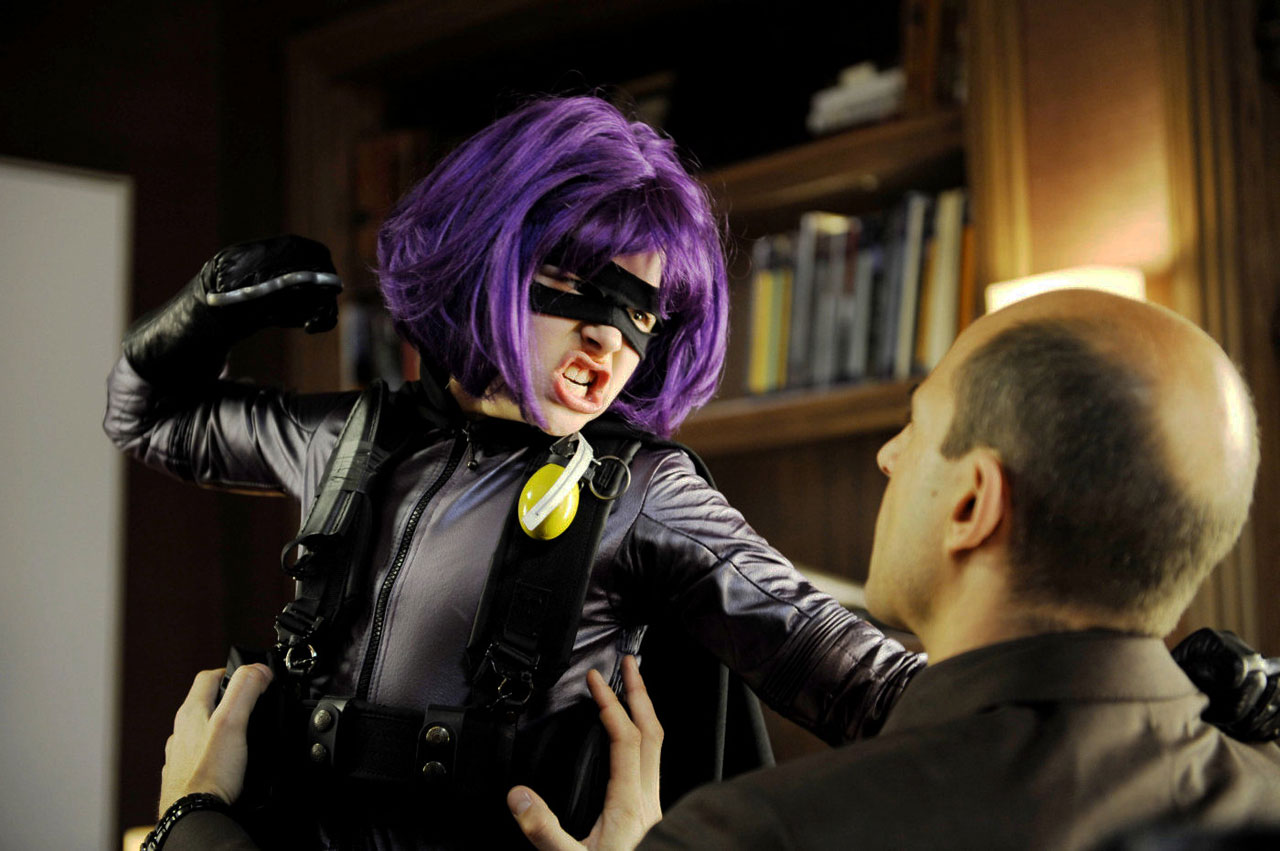
Likewise, a lot has been written about Chloe Moretz’s Hit Girl. The character being considered an emblem of bad taste, the childishness that comes with comic books, and the sheer disgrace at subjecting a child to acts of violence and foul language. It should be noted in a Ken Loach film featuring a child that swears and commits acts of violence would almost certainly be applauded for its harsh realism. It could be argued that Hit-Girl is merely a product of a deranged man (Nicholas Cage’s Big Daddy) who has taken away a child’s innocence. She is a child without a childhood or any understanding of the world girls her age are meant to be experiencing.

So while the subtext is there, it should also be said that Kick-Ass is actually a whole lot of fun and filled with in-jokes to the genre it derides, reinvents and worships. Music cues reference the films gone before it. Several action sequences are interspersed with other media forms (cell phones, security cameras, polaroids) or stylistic traits so unlikely in the medium. Long takes, POV mark the film’s action sequences out as something special, in spite of the obvious budget restrictions. There are no flipped trucks in this film. The jokes are also brilliantly inspired, sometimes just rude, other times directly referencing comic books and their ridiculous concepts. The fact that the film also has a horrifically dark streak of humour running through it, does nothing but add to the enjoyment of the film. A faux assassination, a superhero’s first flight, a car accident, a gay best friend – all appear in Kick-Ass and about as dark as joke as you are likely to find in a film this year.

Saturday, 5 February 2011

8: AMERICAN: THE BILL HICKS STORY


Bill Hicks is a comedy legend. Far more recognised and acknowledged on British shores than his own – deeply satirical, deeply offensive and undeniably hilarious. Yet Hicks passed before he would reach his zenith at the age of thirty two – his star on the rise, never given the opportunity to fall. As a result, his material remains for everyone as his record, but the man himself was never really understood or known. To my generation Hicks is a comedian, an icon, a hero; not a man.

The great thing about American: The Bill Hicks Story is it offers audiences for the first time ever a glimpse into the man behind the comedian alter-ego he put on when stepped onto every stage. Mixing 3D animation with home footage (including his first ever public performance at the age of sixteen) the documentary charts Hicks’ difficult and, at times, painful rise into an uncaring American populace.

Only ten of the comedian’s nearest and dearest contribute to the film painting a real portrait of the comedian rather than merely celebrating his material. Their voiceovers replace standard narration, whilst the animation helps tell whatever parts of the story that are not already documented on video. The animation is a bold move that at the beginning might feel somewhat alien, though quickly settles in comfortably with the alternative comedy performances juxtaposing wonderfully.

No stone is left unturned offering insights into Hicks’ anger at the Bush administration, advertising, Hollywood as well as his rather overwhelming substance abuse problems. It is an undeniably positive portrait of Hicks even in these darker moments. Perhaps being heralded as a genius by members of his own family seem like rather hollow words, but his family are frank in acknowledging they also had problems with what he said when it came to talking about his personal life in his act. Their adoration is retrospective and they acknowledge it.

The performances that are shown are often the classic Hicks. Showcases featuring his hatred of advertising and his mockery of the first Iraq War remind fans of how relevant his material still is, despite their being performed some fifteen years earlier, while showcasing the man’s abilities for those who have never really encountered him before. The very early footage can even provoke jealousy given that his first ever performance is perfectly timed and delivered despite his relatively young age. It is a revelation to realise that while still a boy Hicks could make a crowd of adults laugh uproariously.

The true gem in this documentary though is the brief snippets of home videos featuring Hicks with his family. Displaying a very humane side to the characteristically vitriolic comedian, it is this footage that proves incredibly affecting and this is what marks out this documentary above previous documentaries about Hicks. This film does not just aim to champion and celebrate him, but manages to humanise him. His mother’s recounting of her son’s last days as he became ravaged by cancer is all the more heartbreaking when taken into the context that she is speaking about her son, not just the comedian everyone else refers to him as.


Admittedly, it is a harder watch if you are unfamiliar with the man’s work, but for fans – it is the ultimate record of a man who was a titan of comedy.

Friday, 4 February 2011

9: SHUTTER ISLAND


Off the back of the Oscar and box office success that The Departed afforded him, the world waited a surprisingly long time for Martin Scorsese to follow up that Boston set crime thriller. What arrived was not what anyone expected, despite early indications that he would be staying in relatively similar terrain. Shutter Island is a Boston-set crime film in the literally loosest sense - in a similar way to A Scanner Darkly being science fiction – it is in fact, perhaps the closest the great director will come to ever making a horror.

Leonardo DiCaprio, in the most overlooked performance this year during the awards season, is Federal Marshal Teddy Daniels, assigned with the task of tracking down an escaped patient from a mental institution. The eponymous Shutter Island. Aided by a new partner he ventures onto the island and quickly discovers, surprise surprise, that nothing is as it seems.

Haunted by visions of his time during World War II, his dead wife and the man who killed her; Daniels tries to uncover the mystery of how the patient escaped. Time and time again everything we are set up to believe in is wrecked with the arrival of new information and throughout the genre whiplashes back and forward. This is all about plot, something Scorsese often tries to avoid in his films, and he seems to revel in refusing to accept whatever logic he has applied to the audience. It is pulp, unashamedly so, but in the hands of Scorsese it is masterful pulp.

The film ranks among the director’s most visually stunning works. Whether it is a long take of executed prisoners, the protagonist’s run up the stairs or merely a darkened corridor; every single shot is flushed full of daring that other thrillers would refuse to indulge in. They often choose instead to just have the story play out in front of the camera. Scorsese has never, in the entirety of his hugely accomplished career, allowed visuals to come before his characters; what he does do though, to great success, is integrate them into his stories. Here is no different. These visuals stand beside the characters complimenting each other.

Every character is burned into the brain whether they are the leads or present for only one scene. Notably in the third act, Ted Levine (best known for playing Buffalo Bill in The Silence of the Lambs) shares a scene with DiCaprio that is merely a conversation but is the most uncomfortable conversation you have ever witnessed. Character actors like Jackie Earle Haley, Elias Koteas and Emily Mortimer pull off similar feats where their one scene remains a pulling force throughout the rest of the running time.

Although this is DiCaprio’s film.

Never off-screen, his performance is the one of his career. For the longest time he has been an actor of considerable talent trying to dispel the image of himself on a sinking boat. This might just have been the film that eradicated that image. Whilst uglier than usual (although only ugly in comparison to DiCaprio’s general appearance the rest of the time) it is the character that dispels it. If the audience is expected to root for him, given his clean-cut public image, his actions are often very difficult to support. Arrogant observations and overlooking protocol evolve into at times shocking acts of violence - we realise that this character is difficult to empathise with or indeed support.

There are downsides to this film however that prevents the film from being regarded among Scorsese’s best works. The film doesn’t work on repeat viewings. The shocking twist that ends the film struggles to have the same impact when watching a second time instead, on repeat viewing, becomes a series of ‘spot the clue’ moments reducing the well constructed story to an irrelevance. To examine the film’s plot is like pulling at a loose string – only to see the whole thing fall apart around you. The film just is not as smart as it likes to think it is. As a one-off viewing though Shutter Island is last year’s best.


Thursday, 3 February 2011

10. THE TOWN


In his second effort as a director, Ben Affleck widened the scope and ambition of his story, while remaining faithful to his previous Boston set crime film, Gone Baby Gone. Like that film, The Town is awash with memorable characters that in most other films are glibly featured or merely given a single scene to be shine, then swiftly forgotten. The film refuses to feature a single character that fits the stereotype of its genre - even the ones that do skirt dangerously close to the fringes of cliche are made far more original with select contexts (the late Pete Postelthwaite's crimelord operates from a tiny florists).

The difficulty with The Town for an audience is being asked to take an enormous leap of faith. Fairly early on in the story this leap is offered to the audience. It is a ridiculous concept to fathom and as a result the film struggles to get over the hurdle. It does eventually conquer this bump primarily because everything else that is happening in the film is far more interesting than the central relationship between Affleck's crook and Rebecca Hall's former hostage.

Jon Hamm, the actor formerly known as Don Draper, is largely responsible for this; finally given a sizeable role in a movie and it is he who steals a majority of the film. His rather straightforward-on-the-page FBI agent is wonderfully drawn by the actor, and the accompanying script. Rather than essentially be someone for the audience to hiss at, we are presented with a character who is intelligent, driven and ultimately perhaps just as horrific as Affleck's criminal. His scenes with Blake Lively are wonderful in drawing out his Machiavellian qualities and his complete disregard for the slum characters Affleck as a filmmaker is fascinated with.

Lively herself is a revelation making you instantly forget that she is actually famous for appearing utterly impeccable and vapid. She is essentially a variation on Amy Ryan's character in Gone Baby Gone. An accident waiting to happen - someone the system forgot about or chose to ignore. While Jeremy Renner seems to be taking the only awards plaudits this season - Lively is far more deserving as she truly shows that she has a career beyond Gossip Girl.

Affleck has indeed improved as a filmmaker also, making his scenes less intimate and claustrophobic, in the action packed moments of the film. The Town features car chases and shootouts that recall The French Connection and Heat, and while the film never reaches those heights it is impressive that the film can sit in their league (admittedly at a very different table). These thrilling sequences prove far more immersive than anything 3D has produced for us to date.

The film never feels flabby or overlong nor does it feel like the film is a product of Hollywood despite the very starry, of-the-moment cast. The world Affleck has shown us feels genuine, and untouched by Hollywood gloss. The same goes for his characters and his script. This feels authentic, despite the heightened narrative of cops and robbers. If the aforementioned 'leap of faith' does wound the film it is a film that feels rare at the moment.

Given it did as well as it did at the box office is a testament to there still being a market at the movies for adults. And that perhaps is Affleck's greatest achievement - despite building his acting career on appealing to the very demographic Hollywood adores; as a director he acknowledges the mature audience that is often, criminally so, overlooked.

Tuesday, 1 February 2011

FILMS OF 2010: INTRODUCTION


Before I make any sort of statement it should be said upfront that you won't agree with my list or my summations. Best of lists are never the 'carved in stone' charts people believe them to be. I am simply stating my opinions and why I enjoy the films of the last year. So yes this is a list and encourage conversation on the blog about these various films and whether you liked them or not. To deride is something of an irony though, as many of you will take the time to read each of the blogs that will go up over the next twelve days and you will waste as much time as I have in writing my appraisals for cinema during 2010.

Yes this list is coming out in January. I apologize I'm not 'Social Network - relevant and current' but I have a job, and formerly had a degree to achieve so I missed certain things in the cinema and wanted to make sure that I caught up on everything that was supposedly great about 2010 at the movies. Now, I have still missed things but a blog in June about 2010 in cinema is particularly relevant. It isn't particularly relevant at the start of February either; but then again I feel if people read this then they might at least acknowledge I still write on this website from time to time. That and I felt that merely posting a list last year was rather lazy. At least in this format I give reason.

I have missed a few key movies and for that reason: don't hit me. Cyrus, Winter's Bone, Monsters and Easy A all passed me by. They will be discounted and certainly I will probably kick myself later for not seeing one of these films when I should have done. For that scold me, but if you want my opinion to encompass every film at the cinema this year send in donations for cinema tickets and I will happily get everything seen without feeling the pinch of an empty wallet.

Anyway, how was 2010 in cinema?

In comparison with last year it was incomparable, it was wonderful and joyous and too many great films to be had. I mean that. For once the cinema seemed to constantly be showing films that appealed to various audiences and not just the Bay crowd. By that I mean adolescent boys/ man-boys of a certain age group. The teenage man factor. This year women were catered for, with alternative programming - The Kids Are Alright, Winter's Bone, Going the Distance, Please Give, Sex and the City 2 (that one might not be appropriate). This year adults were genuinely considered at the movies - Shutter Island, The American, London Boulevard, Crazy Heart, The Town all came from the woods of Holly to entertain to the adults with no concessions made for the youngsters. Granted some are more fantastical than others in the adult department but never did the film cop out (a film by that very moniker did just that) for a cleaner brand of entertainment.

Not only that but animation ran rampant. Pixar closed off the greatest trilogy ever apparently (they did not). Comic book films upped the ante by daring to be wildly different in just about every way imaginable. The Eighties was revisited in the form of men on mission movies - some recollections far more blurry than others. Blockbusters were for the most part immediately seen and then instantly forgotten. World cinema became worthy of being seen on the big screen with the release of the Steig Larsson trilogy. A Prophet and The Secret in their Eyes showed us that world cinema could do the genre work as well, and maybe better, than the Hollywood system.

And Danny Boyle won an oscar for best director for a film about a Mumbai street urchin who speaks English, was distributed by Americans and was largely subtitled.

Wait! That was last, last year! No a woman won this year for making a non-political film about a political hot button topic and featured entirely a cast of men who practically ate machismo.

That's not the point. At any rate, I include my ten favourite films of last year and a further blog about the great films I felt that did not quite make the cut. It is this final blog post that I hope you'll pay attention to the most; if you can at all gauge attention levels when reading a blog. Clearly you are all students, unemployed or you have time to kill on the commute. For whatever reasons, these films were often overlooked by audiences when released and that is criminal. I am trying to start a cult club early. Let's not wait ten years for a film to become another Fight Club. See these movies now. Some you will know and definitely revolt against but these are just opinions. The others you maybe haven't are the more important ones. Until you've seen them you have no basis for argument, so shut up and watch them before you start whining. Ironically though, I will tell you to silence yourself after you've seen these films if your opinion doesn't immediately correspond with my own.

Enjoy over the next eleven posts. Agree, Disagree. Just make sure you've them before you give me grief.

And yes I am fully aware that this blog does nothing towards my goal of a top ten list, but hey...I like to write.